


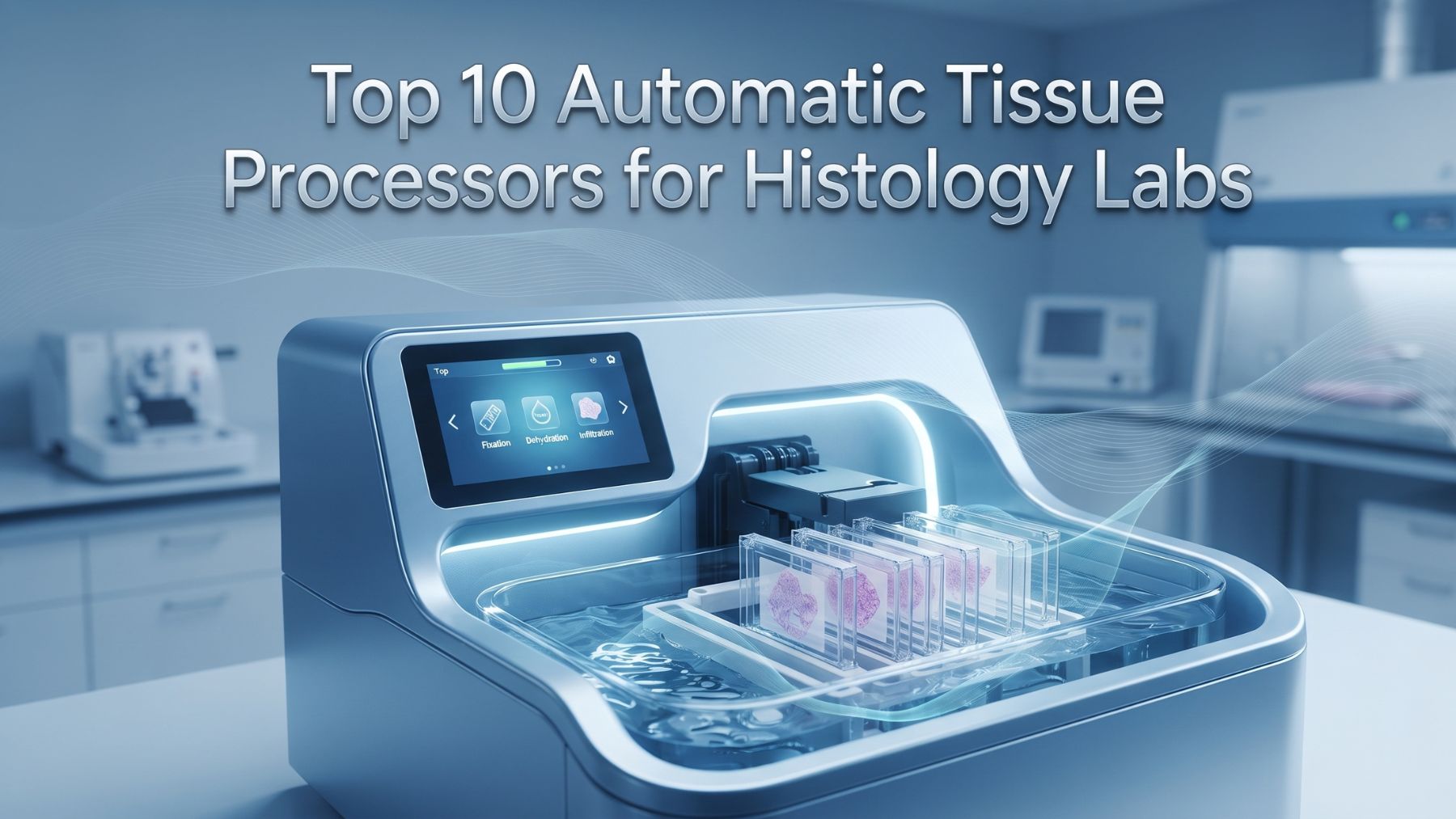
Diagnostic accuracy hinges on tissue preparation quality in every histology lab. Automatic tissue processors are critical in the dehydration, clearing, and paraffin infiltration stages of tissue preparation. Modern labs have invested in automated tissue processors to streamline their operations, minimize the need for manual staff, and provide consistent quality.
When it comes to setting up a new pathology lab or modernizing existing equipment, the productivity and specimen quality improvements associated with the selection of an automatic tissue processor are significant.
Histology professionals worldwide agree on the reliability and features of the following tissue processors.
1. Leica ASP300 S Tissue Processor
Intelligent reagent management and specimen protection systems set this tissue processor apart. Useful in high-volume clinical pathology labs, the Leica ASP300 S features programmable processing cycles and reagent monitoring with a remote alarm.
Key Features:
- Intelligent reagent management
- High-capacity specimen processing
- Remote monitoring and alarms
- Reliable overnight operation
Click here to know more: https://www.leicabiosystems.com/sites/default/files/media_product-download/2021-03/95.11569_Brochure_ASP300_S_EN.pdf
2. Sakura Tissue-Tek VIP® 6 AI Tissue Processor
AI-assisted monitoring and rapid processing provide the Tissue-Tek VIP 6 AI with a great balance of efficiency, high quality tissue, low reagent waste, and low processing error.
Best For:
- Large diagnostic laboratories
- High-throughput pathology departments
Click here to know more: https://www.sakuraus.com/Products/Processing/VIP-6-AI.html
3. Thermo Scientific Excelsior AS Tissue Processor
The Excelsior AS offers precise reagent control, automated scheduling, and excellent tissue preservation. It’s user friendly for demanding labs.
Highlights:
- Automated reagent manipulation
- Versatile processing protocols
- Outstanding specimen safety
Click here to know more: https://documents.thermofisher.com/TFS-Assets/APD/brochures/ExcelsiorASBrochure.pdf
4. Milestone LOGOS EVO Hybrid Tissue Processor
The LOGOS EVO features hybrid microwave assisted processing and significantly improved processing times while maintaining excellent morphology. It is ideal for labs needing same day diagnosis.
Benefits:
- Microwave assisted processing
- Quick turnaround
- Process energy efficiency
Click here to know more: https://www.milestonemedsrl.com/products/tissue-processing/logos-evo/
5. Medite TPC 15 Duo Tissue Processor
With dual retorts and advanced automation, the Medite TPC 15 Duo processes multiple sample batches simultaneously and greatly improves productivity while maintaining high quality tissue.
Best for:
- Medium to large pathology labs
- Continuous workflow
Click here to know more: https://www.medite.de/en/tpc-15-gewebe-entwaesserungsautomat/
6. Diapath Donatello Tissue Processor
With the Donatello, you get consistent processing due to the combination of intelligent software and dependable hardware. This processor is easy to operate and reduces errors due to its touch screen interface.
Benefits:
- Easy to operate software
- Programmable protocols
- Advanced Reagent Management
Click here to know more: https://www.diapath.com/products/instruments/tissue-processors-41
7. Dakewe HP300 Plus Tissue Processor
The HP300 Plus is a dependable processor that offers automated processing and advanced safety features. It is an ideal choice for histology labs that require consistent, dependable processing.
Features:
- Automated reagent exchange
- Safety features
- High quality processing
Click here to know more: https://www.dakewemedical.com/histology-tissue-processors/HP300_Plus_Tissue_Processor.html
8. Slee MTM Tissue Processor
The Slee MTM series tissue processors are designed for labs that require a high level of customizability with excellent reagent circulation.
Best for:
- Diagnostic labs
- Research labs
Click here to know more: https://www.slee.de/en/products/mtm-i-ii/
9. Amos Scientific Tissue Processor
Amos Scientific provides compact and powerful tissue processors that are easy to maintain and designed for labs that process a moderate volume of samples.
Benefits:
- Minimal space requirement
- Simplified programming
- Reduced overall costs
Click here to know more: https://www.amos-scientific.com/products/tissue-processor/
10.Unimeditrek Automatic Tissue Processor
The Unimeditrek Automatic Tissue Processor is perfect for busy histological and pathological labs. With a focus on reliability, speed, and consistency, it is easy to see how this product would add value to any lab. Automation and intuitive controls allow our users to experience less downtime with their prep and even have time to focus on other areas of lab work. This time savings comes without compromise to specimen integrity. Unimeditrek tissue processors are designed for use by hospitals, diagnostics, research, and teaching labs.
Features that Matter:
- All the automation you need for handling tissue and achieving the results you need
- Controls that can be designed to fit your labs specific needs
- Processing need touch of a button
- Tissue processors that think and work for you
- Designed for histology use with high reliability and built-in safety features
- High throughput use and routine histology applications are easily accommodated
Click here to know more: https://www.unilabequipments.com/products/automatic-tissue-processor
Reduced user intervention
Factors to Consider When Selecting an Automated Tissue Processor
There are several things a lab needs to evaluate when selecting an automated tissue processor:
- Sample Capacity: The processor should be able to accommodate the lab’s daily sample capacity.
- Speed of Processing: The time taken to process the tissue should be as brief as possible to enhance the turnaround time for diagnosis.
- Reagent Management: The processor should have automated monitoring of the reagents to minimize wastage while ensuring the quality of the process.
- Safety Features: The processor should have safety features such as vacuum monitoring and power-failure/preset protection to ensure the safety of the specimen.
- User-friendliness: The processor should have a user-friendly interface such as a touch screen and programmable features for daily ease of operation.
Cost: The processor should be designed and built for a low maintenance cost over a long lifetime.
Availability of Parts and Technical Support: Parts and technical support should be readily available to ensure that the processor remains operational.
Conclusion
Automated tissue processors are an essential part of any modern histology or pathology lab. These systems automate a previously manual step in the diagnostic process and thus improve the timeliness and accuracy of a laboratory’s results.
Whether you need a small tissue processor for basic lab functions or a large tissue processor for a high-capacity pathology lab, a significant improvement to the workflow and quality of the lab can be expected from the purchase of an automated tissue processor. When choosing an automated tissue processor, a good balance between the safety features, processing speed, capacity, and automation features should be sought to meet the needs of the lab’s histology framework.