


As healthcare evolves to become more anticipatory, it is the field of diagnostics that is changing the manner in which we understand, manage, and prevent disease.
Healthcare at a Crossroads
Today’s healthcare system is focused less on how effective it is in treating disease and instead is focused on how early it can identify risk, how soon it can prevent the disease from worsening, and how individualized it can make its treatment. Diagnostics are at the heart of this change, evolving from a mere tool to confirm disease to a system that provides strategic intelligence on how healthcare will be delivered.
The change in diagnostics is reshaping the clinical pathway, empowering the clinician and putting the patient in the driver’s seat of decision making.
Prediction: Foreseeing Disease Before It Strikes
The field of predictive diagnostics and disease intervention is, for the first time, changing the experience of early intervention. Advanced biomarkers, genomics, and artificial intelligence analytics allow clinicians to identify disease susceptibility before any clinical signs are present.
The following are some of the most important advancements that are leading to predictive care:
- Genomic risk profiling for chronic and inherited diseases
- AI-powered image and pathology interpretation
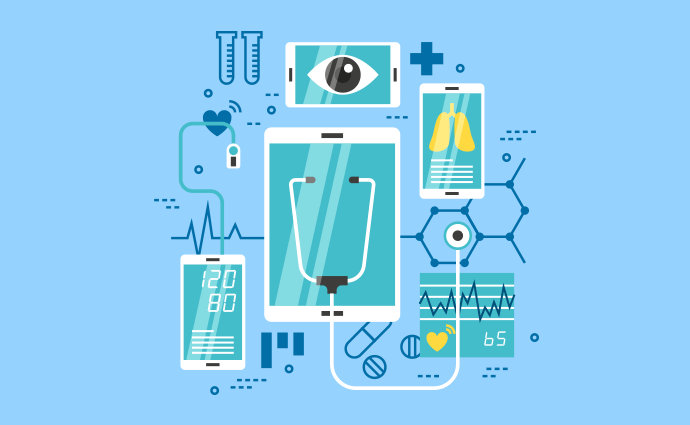
- Connected diagnostic instrument real time data analytics
The predictive capabilities of these technologies will enable healthcare systems to shift from reactionary care to proactive and predictive disease and risk management, significantly cutting the burden and cost of disease over time.
Prevention: Diagnostics as the First Line of Defense
Prevention is no longer an objective of policy– but rather, an outcome of diagnostics. Screening programs, surveillance testing, and wellness diagnostics will become a staple of public and private healthcare.
Diagnostics assists preventive measures by:
- Early detection of cancer, metabolic disorders, and infectious diseases
- The ability to monitor population health and maintain readiness for infectious disease outbreaks
- Providing measurable health indicators that are used to determine lifestyle changes and/or therapeutic interventions
In this model, once again, the laboratory becomes more than a service provider; the laboratory becomes a steward of public health.
Personalization: Tailoring Care to the Individual
The era of “one size fits all” medicine is coming to an end. Diagnostics is the starting point of the new treatment paradigm, one that is centered around the individual’s biology, environment, and disease profile.
Personalized diagnostics is pivotal in:
- Companion diagnostics for personalized therapies
- The assessment of treatment effectiveness and progression of disease
- The avoidance of trial-and-error prescribing
The integration of diagnostics and therapeutic i.e. outcome-based, safer, and more effective care.
The Integration of Technology and the Diagnostics Shift
The rapid convergence of technology is powering the diagnostic shift:
Molecular & Multi-Omics Diagnostics
Multi-Omics, i.e. genomics, proteomics, and metabolomics, provide a more comprehensive understanding of the mechanisms underlying diseases and the variability among patients.
AI, Automation and Digital Pathology:
AI and Automation both positively impact pathology and laboratory workflows. While AI cuts down on time spent diagnosing, and is most useful in large volume, highly complex diagnostic testing; Automation increases the number of patients that can be diagnosed in a given time frame.
Point-of-Care and Home-based Testing
As patients are given the ability to test themselves and collect diagnostic samples, they no longer have to wait for the longest stretch in a laboratory diagnostic test’s workflow – the sample analysis. Testing specimens can be analyzed at the point of care and laboratory samples can be analyzed at home.
Integrated Digital Ecosystem:
As diagnostic data moves to the cloud, data from various laboratory information systems (LIS) and electronic health records (EHR) are providing interoperable and actionable clinical data.
India’s Diagnostic Evolution:
A Precision-Driven Future: The rapid integration of healthcare technology, policy-based healthcare systems, and increased public health consciousness are fostering the transition of accurate predictive, preventive, and personalized diagnostics.
The following are the primary factors influencing the future of diagnostic processes in Indian healthcare:
- Widening access to cutting-edge diagnostic tools, quality testing, and services;
- The integration of AI, and Automation within Indian healthcare laboratory systems;
- The increase in healthcare consumerism and demand for pre-emptive diagnostic evaluation;
- The necessity for partnerships across the diagnostics, pharmaceuticals, and digital health industries.
The evolution provides for establishing diagnostics as the foundation for the future of sustainable growth in healthcare systems.
Obstacles to Achieving Precision Healthcare
The migration is shifting. However, the following challenges will continue to face the industry:
- Affordability and access issues
- Quality and regulatory challenges
- Privacy, security, and data interoperability issues
- Shortage of diagnostic and data science professionals
The ability to resolve these challenges will be the greatest factor to the potential of predictive and personalized healthcare.
The Future Diagnosed
The future of healthcare will be defined not by hospital beds or treatment volumes—but by how early, accurately, and personally disease can be diagnosed.
Diagnostics is no longer working behind the scenes. It is leading healthcare’s next chapter—one where prediction prevents suffering, prevention reduces costs, and personalization improves lives.