


The future of critical care brings together an integrated system of advanced technologies to deliver preemptive, precise care.
This includes predictive artificial intelligence (AI), advanced imaging technologies, and the necessary smart infrastructures within our Intensive Care Units (ICUs).
Historically, care in ICU has been mainly reactive. This is because most monitoring systems do not pick up on physiological changes until after they have occurred. Because of the demands of increased patient complexity, the burden of chronic diseases and the need to achieve better outcomes, healthcare systems must transition away from reactive care models.
Predictive AI: Foresee Risk Conditions
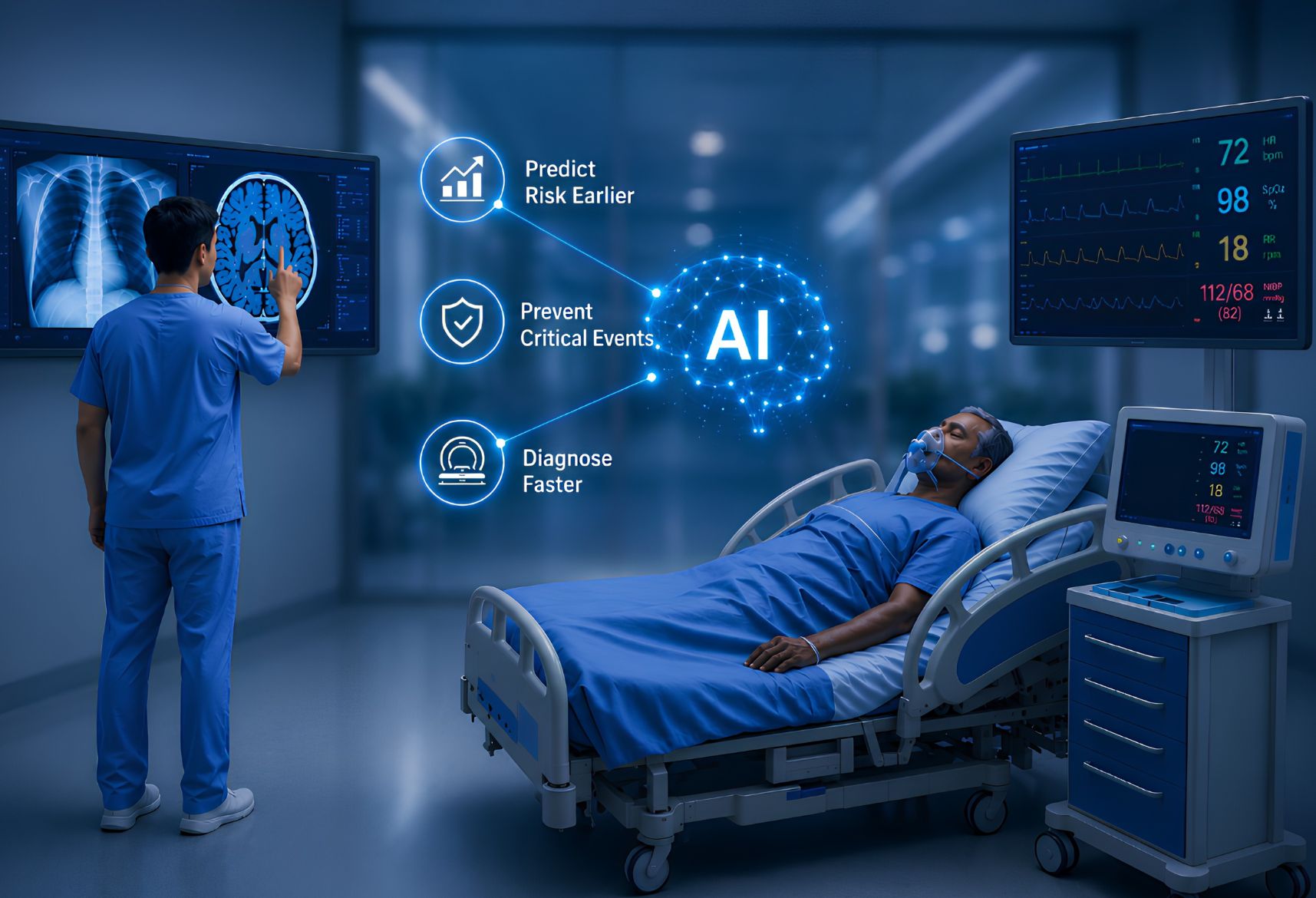
The modern critical care centre is a smart, data-rich, and evolving environment, with the capacity to provide care that is both proactive and precise. This means that critical care environments must have the capability to anticipate the deterioration of a patient before significant signs and symptoms of that deterioration become apparent.
One of the most critical components of this transformation is predictive AI.
AI can analyze massive volumes of time sensitive data, including not only vital signs and laboratory results, but also electronic health records (EHRs), medication histories, and even physiological waveforms.
Predictive AI has the capacity to identify clinical patterns that may go undetected by passive monitoring systems.
Advanced Imaging: Faster Clinical Decisions
New technologies for diagnostic imaging are impacting workflows used in critical care. The design of next-gen critical care centers is changing to include point-of-care ultrasonography (POCUS), portable CT scanners, AI-enabled imaging analysis, and advanced functional imaging within or very close to ICU’s.
Bedside imaging streamlines the diagnostic process, cutting down transport risks for the severely ill, and makes therapeutic decisions easier to implement.
Imaging workflows are enhanced with the addition of AI, enabling automated image reconstruction and dictated findings, and improving the speed and reliability of clinicians’ detections of intracranial haemorrhages, pulmonary embolisms, and cardiac dysfunction.
When combined with clinical and physiological datasets, imaging creates a multidimensional depiction of a patient’s condition, allowing highly focused and personalized critical care.
Smart ICUs: Connected Care
The operational framework for this integrated technology is provided by Smart ICUs. Smart ICUs use interconnected medical equipment, interoperable electronic health records, various remote monitoring systems, and centralized data storage, to facilitate seamless information sharing to every member of a multidisciplinary team.
Organizational support systems can offer recommendations on the next actions for clinicians, based on rapid synthesis of real-time data from bedside monitoring, lab imaging, and a variety of predictive services.
This fosters a high level of situational awareness in the clinical environment and helps to ensure that decisions are based on the best available data.
From Reactive Monitoring To Precision Care
This impacts clinicians significantly. The time to process diagnostics is greatly reduced and assessments can easily move from episodic to continuous.
Identifying deterioration earlier leads to several benefits. Interventions can be carried out with a decreased length of stay in the ICU for the patient, a decrease in the financial burden of healthcare, and with an improved survivability of the patient. Predictive and precision-based care models are also concerned with the best use of resources. This balance is becoming more important with the increasing demand for care that is more intensive and the shortages of staff able to provide that care.
As healthcare organizations build critical care centers that are ready for the future, the investments that they make need to include more than just the technologies. Interoperability, data governance, cybersecurity, clinician training, and the management of change all need to be included.
The future of critical care will be focused on more than just the treatment of critical illness. It will also be focused on the prediction and prevention of critical illness, and the individualization of care. This will change the way that intensive care units function.
They will cease to be environments for the monitoring of patients in a reactive manner. Instead, they will be able to function as intelligent care ecosystems that will provide the most needed care at the most needed time.
About Author:
Dr. Manivannan Selvaraj
MD, DnB
Founder and Managing Director
Kauvery Group of Hospitals
Dr. Manivannan Selvaraj is the Founder and Managing Director of Kauvery Group of Hospitals. Dr. Manivannan is a trained anaesthesiologist.
His vision of making great healthcare affordable became a reality in 1999, when he co-founded Kauvery Hospital along with Dr. S. Chandrakumar. Kauvery Hospital’s mission is to bridge the burgeoning gap in trust between patients and hospitals, and to restore the importance of empathetic healing.
Dr. Manivannan’s firm belief in the adoption of best practices to eliminate wastage, rationalize treatment and optimize patient stay in the hospital helps in reducing the cost of treatment, thereby making great healthcare affordable.
This also helps in reducing the negative impact on tertiary healthcare due to complexities of various diseases and the lack of availability of high-end investigation tools.
Dr. Manivannan’s focus on implementation of lean methodologies and 5S practices has helped Kauvery Hospital win several awards in 5S, Quality Circle initiatives (employee’s ability to assess and resolve issues on their own).